Last updated 2026-08-19
TL;DR
Arkansas has no standalone ironworker license. You can hire on as a helper or apprentice with no state trade card. The real path is a registered 3 or 4 year apprenticeship, OSHA steel erection training, and a contractor license only if you bid commercial jobs at $50,000 or more. Costs stay low if a union or contractor trains you. Confirm any board fee before you pay it.
Do you need a license for ironworker work in Arkansas?
No. Arkansas issues no standalone occupational license for an individual ironworker. You can hire on as a helper or apprentice without a state ironworker card. The license that exists is a contractor license, and it sits on the company that bids the work, not on every fitter on the deck.
That mix-up stalls people for months. A buddy hears "license" and thinks this trade works like an Arkansas electrician card. It does not. The Arkansas Contractors Licensing Board regulates contractors. It runs no journeyman ironworker exam.
State law defines a contractor as a person who, for a price, bids or performs construction when the cost of the work is "fifty thousand dollars ($50,000) or more." That line is in A.C.A. § 17-25-101. [2] If you are on someone else's payroll, you are not that contractor.
You still follow OSHA steel erection rules. Your employer still needs workers' compensation once headcount hits the state trigger. GCs will still ask for site cards. None of that is an ironworker license.
Residential jobs sit on a different track in the same chapter of the code. If you later take house or small-building steel under your own name, read the residential contractor subchapter and confirm the current dollar trigger with the board before you bid. Do not guess from a forum post. [4]
For the contractor-side paper in more detail, use ironworker license in Arkansas. Read that page before you print business cards.
How do you actually start as an ironworker in Arkansas?
You start by getting hired into the trade, not by mailing a state application. A high school diploma or GED is the usual floor. BLS says structural iron and steel workers typically need that diploma to enter an apprenticeship. [1]
Call the Iron Workers local that covers your county, or walk into a structural or rebar yard and ask about helpers. Bring a short resume, a valid driver's license, and time for a drug test that week. Many yards will not talk long without an OSHA 10 card. Get that card first if you can pay for a single Outreach class.
A registered apprenticeship is the clean paper path. Paid jobsite hours plus classroom hours. The U.S. Department of Labor lists ironworking as a registered apprenticeship occupation, and Arkansas workforce staff keep a state list of registered programs. [8] [15]
Have these ready: photo ID and Social Security number for Form I-9, diploma or GED, a driving record if they run a crew truck, and any old OSHA, first aid, or welding tickets. Leave the three-page personal essay at home.
Do not buy a private welding school package unless a contractor named the process they need. A lot of that tuition is wasted if the shop welds to its own procedures and its own coupons.
Physical reality is simple. You will climb, pack, and work off decks. If heights freeze you, pick another trade now. Nobody has good public washout data for Arkansas ironworker classes. Work is weather-stopped. Plan on winter slowdowns from Northwest Arkansas to the Delta.
If you live near the state line, compare intake habits in how to start ironworker in Alabama. The paper is similar. The hall and the yards are not the same list.
How long does ironworker take in Arkansas?
Most people take 3 or 4 years to reach journeyworker status through an apprenticeship. BLS states it directly: "Most structural iron and steel workers learn their trade through a 3- or 4-year apprenticeship." [1]
That clock starts when you are indentured, not when you first searched the trade. Getting into a class can take weeks or many months. Work on the books drives the list. I will not invent an Arkansas processing time. Locals and contractors set their own intake.
Registered programs mix paid hours with related instruction. The union apprenticeship covers structural steel, reinforcing, ornamental work, welding, and rigging across a multi-year program. Hour totals commonly land in the 6,000 to 8,000 range in national program standards. Confirm the standard for the program that accepts you.
You can work sooner than journey status. Helpers and first-year apprentices get on iron after orientation and the employer's required training. You are not waiting four years to draw a check.
If you already have documented hours from another state, ask about credit. Some hours transfer. Some do not. Get the answer in writing.
Open-shop NCCER paths can also take a few years of modules plus hours. The paper looks different. Journey-level pay still waits until a contractor or a union book says you are there. There is no state shortcut that turns a summer of helper work into a license, because there is no individual license to issue.
How much does ironworker cost in Arkansas?
Starting as an employee is cheap next to trades that force school first. Your real spend is boots, a belt, PPE, and whatever initiation or book fee a local charges. I will not invent those local fees. Call the hall and ask for today's number.
Waste of money: an $8,000 private "ironworker certification" that ties to no registered apprenticeship and no contractor who already said they will hire you. The paper that moves the needle is a registered program completion, plus OSHA and the welder quals the shop actually uses.
Honest first-month ranges look like this. Work boots that meet ASTM F2413 often run $120 to $250. Many contractors issue a harness. If you buy your own, a usable harness often sits around $80 to $200, and the site may still reject personal gear. A starter pile (spud wrench, bull pin, belt, tape) often lands around $150 to $400 if you buy used where it is safe. OSHA 10 through an authorized Outreach trainer is commonly under $100, and some contractors pay it. [13] A drug screen is often employer-paid. If you pay, budget tens of dollars, not thousands.
Union initiation and monthly dues vary by local. Confirm. Do not send money to a random site that claims it is the hall.
If you later form a company, add Secretary of State entity fees, a free EIN from IRS, insurance, and contractor license costs. License application fees change. Confirm them on the Contractors Licensing Board materials before you write a check. [10] [11]
Nobody publishes a clean statewide "cost to become an ironworker" study for Arkansas. The closest honest number set is national wage data from BLS plus the $50,000 contracting trigger in state law. [1] [2]
A binder of checklists will not get you indentured. If you still want one while you wait on a class date, IronworkerPath sells a $129 one-time Apprenticeship + Cert Kit at /start. You do not need it to apply. Most people who get in do it with a phone call and a pair of boots.
What is the union apprenticeship path in Arkansas?
Iron Workers locals cover Arkansas through the International Association of Bridge, Structural, Ornamental and Reinforcing Iron Workers. Coverage maps change. Use the international locator, not an old Facebook flyer.
Expect an application, a basic math and reading screen, an interview, and a drug test. When mills, plants, and highway lettings are busy, classes move. When they are not, you wait. That is the honest cycle.
Related instruction covers blueprint reading, structural steel, rebar, welding, cranes and rigging, and OSHA steel erection. Jobsite hours are the other half. You work for a signatory contractor. You are not a full-time student.
Pay scales live in the local agreement. I will not invent a first-year percentage. Ask for the current apprentice schedule. BLS reports a national median wage of $62,760 a year for structural iron and steel workers as of May 2023. That is a journey-level, all-states figure, not your first Arkansas check. [1]
If Little Rock or Northwest Arkansas is slow, some apprentices travel. That is a lifestyle choice. It is also how a lot of people finish hours.
Keep copies of your apprenticeship agreement and class transcripts. Those pages matter later if you change locals or apply for a contractor license.
Can you start ironworker work in Arkansas without a union?
Yes. Open-shop structural, rebar, and miscellaneous metals shops hire helpers in every metro. You learn on their iron. Some use NCCER ironworking modules. Some pair you with a fitter and hope for the best.
The risk is paper. If you later want a PLA job or need to prove hours to a registered program, informal helper time can vanish. Keep a log: dates, contractor, hours, tasks, supervisor name. Pay stubs help.
I would still get OSHA 10, fall protection, and first aid on day one. Those cards transfer. A shop T-shirt that says certified does not.
Non-union does not mean unlicensed contracting. The $50,000 commercial rule still applies if you start bidding under your own name. [2]
People also mix this up with electrician or plumber rules. Those trades have individual licenses in Arkansas. Ironwork does not. That is why pages like ironworker license in Alabama can look different. Read the state you will actually work in, not the state with the loudest Facebook group.
When do you need an Arkansas contractor license for ironwork?
You need the contractor license when you are the person or company contracting the work at or above the statutory dollar amount. You do not need it to tighten bolts for a licensed contractor.
A.C.A. § 17-25-101 sets the commercial contractor definition at fifty thousand dollars ($50,000) or more. [2] A.C.A. § 17-25-301 then requires a license before you engage in that business. [3]
The board publishes classifications and applications. Confirm the class that fits structural metals, the exam rules, the financial statement rules, and the fee. Those items change. I will not quote a fee I cannot pin to today's board document.
Residential projects can trigger a separate residential contractor license under Subchapter 5. That track is not the same application as commercial work. Read A.C.A. § 17-25-505 and confirm the current trigger with the board before you take a house steel job in your own name. [4]
Out-of-state contractors need to look at Arkansas reciprocity and any temporary permit the board still offers. Do not assume a Texas or Missouri card is enough. File first.
Public work adds wage paperwork on federal jobs. That is a contracts problem, not an ironworker card problem.
If you want to see how different this gets once you leave the state, read how to start ironworker in Arizona and how to start ironworker in California.
What safety cards and training do Arkansas ironworkers need?
You need the training your employer and the GC require, plus whatever OSHA already put on the employer. Arkansas has no ironworker safety license.
OSHA's steel erection standard is federal. It applies on Arkansas jobs OSHA covers. Subpart R requires employers to train workers exposed to steel erection hazards. The rule text is blunt: "The employer shall train each employee exposed to the hazards associated with steel erection activities so that the employee recognizes the hazards of the operation." [5] [6]
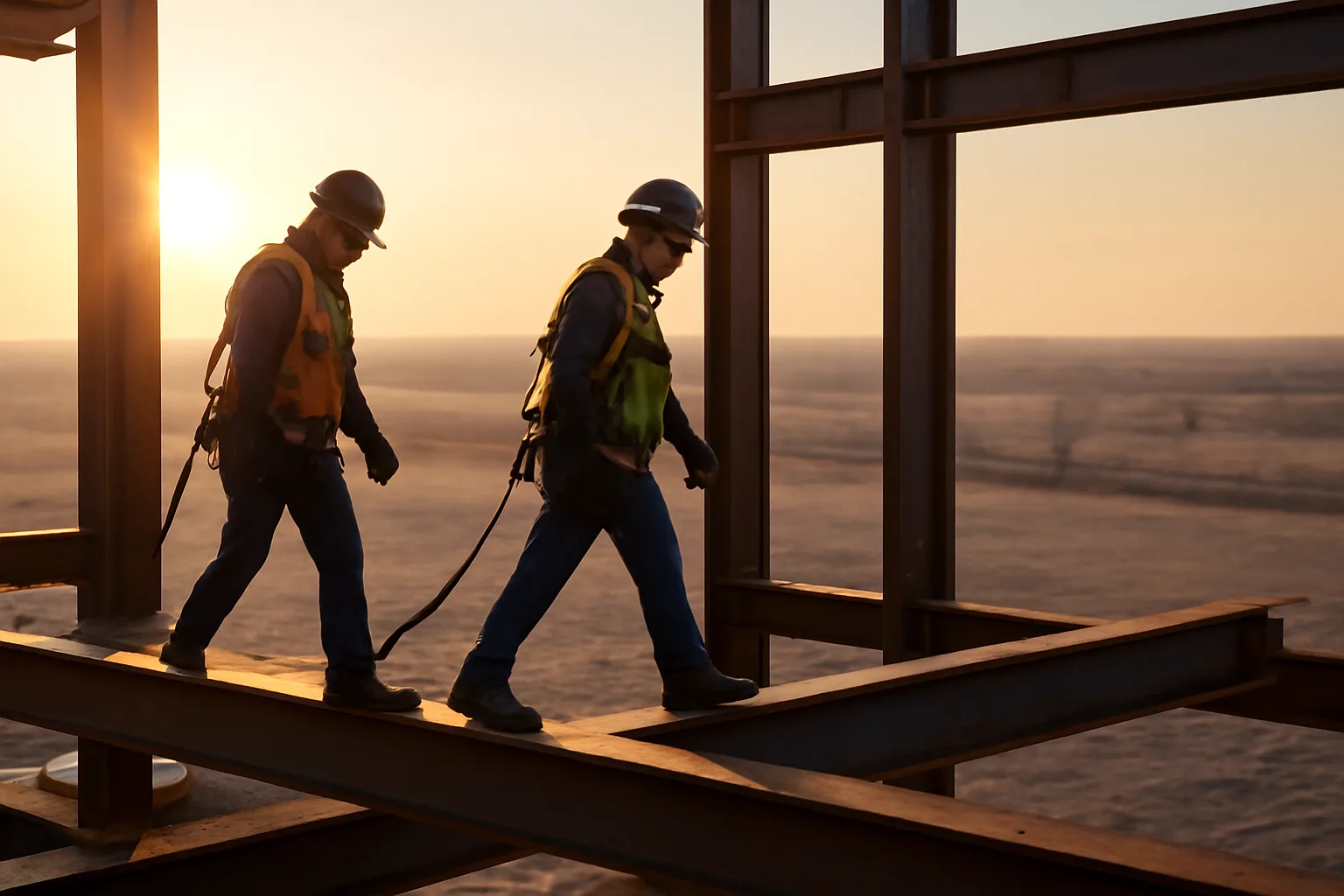
Fall protection at more than 15 feet is the Subpart R baseline for a lot of steel erection work. Connectors and decking have their own paragraphs. Read 29 CFR 1926.760 rather than a meme. [14]
What GCs actually ask for in Central Arkansas and Northwest Arkansas is boring and consistent. OSHA 10, sometimes OSHA 30 for leads. Site orientation. Often first aid and CPR. A rigger or signalperson card if that is your task. Welding certs only if you will weld.
OSHA Outreach classes have to come from authorized trainers. The agency explains that on its Outreach page. [13] A 10-hour card is not a license. Many GCs treat it as stale after a few years even when people argue about printed expiration dates. Keep the student completion card.
I would not pay for a fancy weekend "ironworker safety academy" if your contractor already runs Subpart R training. Duplicate training is a waste.
What tools and gear should you buy first in Arkansas?
Buy boots and a belt. Wait on the exotic stuff until a journeyman tells you it will get used.
First week gear is dull on purpose. Six-inch or eight-inch composite-toe boots that meet ASTM F2413. Leather gloves you can still feel a bolt head through. A 25-foot tape, a 12-inch spud, a bull pin, and a sleever bar if they want you packing one. Clear and tinted glasses. Hearing protection. Weather layers. Arkansas summers cook deck plate. A January morning on a Little Rock frame will surprise people who packed for Houston.
Do not show up with a $400 harness in a custom bag if the contractor issues PPE. Some sites will not let personal fall gear on the iron unless it matches their program.
Mark your tools. Tools walk.
Skip the full display wall at the big-box store. Buy what your lead tells you to buy after week one. That advice will save you more than any internet kit list.
If you weld, the shop's procedure dictates machine, wire, and coupon. Your garage MIG does not make you qualified.
How do you start an ironworking business in Arkansas?
That is a different project. Now you are a contractor, an employer, or both. The trade skill is not the license.
Here is the order I would actually use. Decide on an entity and file with the Arkansas Secretary of State. Current filing fees live on the Business and Commercial Services forms and fees page. Confirm before you file. [11] Get a free EIN from IRS. Do not pay a reseller. [10]
Talk to an insurance broker who already writes steel erection. General liability, inland marine for gear, auto, and workers' compensation. Arkansas generally brings employers with three or more employees into workers' compensation. Confirm how they count officers against the current statute text. [12]
Apply for the contractor license if you will bid at or above the statutory amount. Financials, exam, classification. Confirm every line with the board. [3] Add city or county privilege licenses where you hang a shop. Write a safety program that matches Subpart R, not a copied PDF from another state.
You will spend more on insurance than on the state license in most years. That is normal. Underinsured steel erection is how a company dies on the first claim.
IronworkerPath is an independent publisher, not a law firm and not a service company. Use the board and a lawyer licensed in Arkansas for filings. If you want the checklist pack after you have read the statutes, it is at /start. The statutes still control.
What does ironworker pay look like in Arkansas?
BLS reports a national median wage of $62,760 a year for structural iron and steel workers as of May 2023. [1] That is not an Arkansas guarantee.
State OEWS tables move every year. Pull the current Arkansas row for SOC 47-2221 on the BLS occupational employment page before you budget a household around a number. [17]
Apprentice pay is a percentage of journey scale in union shops. Open shops set their own helper rates. Overtime on shutdowns is where some people get ahead. Weather days cut the other way.
Federal and many assisted jobs pay Davis-Bacon determinations, which can sit well above a private shop rate. Those wage decisions are published by DOL for each county and classification. Read the decision in the bid docs.
I have not seen a high-quality public study of Arkansas ironworker take-home after travel and downtime. Treat social media day-rate screenshots as entertainment.
What paperwork should you keep from day one?
Keep a folder. Paper or phone scans. You will need it when a hall, a GC, or a licensing clerk asks for proof and you are standing in a parking lot.
Save OSHA cards, both sides. Save welding procedure qualification records with process, position, and thickness. Save first aid cards. Save pay stubs and a personal hour log. Save your apprenticeship agreement and related-instruction transcripts. Save toolbox talk sign-ins if you ever need to show training. If you get hurt, file workers' compensation through the employer and keep the paperwork. Deadlines matter.
If you later apply for a contractor license, the board will want experience documentation. A messy year of "I was on a crew" with no proof is a weak file.
For license mechanics, stay with ironworker license in Arkansas. For how another large state writes the same story, ironworker license in California is a useful contrast.
What mistakes waste time when you start in Arkansas?
Waiting for a state ironworker license that does not exist. That is the big one.
Paying a middleman for an EIN. Buying a welding diploma before a contractor named the process. Posting that you are "fully licensed and insured" when you have a truck and a grinder. That last one can become a contracting problem under A.C.A. § 17-25-301 if the job size crosses the line. [3]
Skipping the drug test window. Crews will move on.
Ignoring fall protection because someone said connectors never tie off. Subpart R has connector rules. It has no "we have always done it this way" exception. [6] [14]
Starting a company on a handshake with no workers' compensation plan. One bad step off a beam and the medical bills own you. [12]
Copying another state's playbook. How to start ironworker in Colorado is not the Arkansas path. Use Arkansas statutes, then confirm fees with the board that collects them.
Frequently asked questions
Do you need a license for ironworker in Arkansas?
No individual ironworker license exists in Arkansas. You can work as a helper or apprentice without a state trade card. A contractor license applies if you bid commercial work at $50,000 or more under A.C.A. § 17-25-101. Residential jobs can trigger a separate contractor license. Confirm classifications with the Contractors Licensing Board before you bid in your own name.
How much does ironworker cost in Arkansas?
As an employee, plan on a few hundred dollars for boots, a belt, and basic hand tools, plus any union initiation the local actually charges. OSHA 10 is often under $100. Do not pay thousands for a private "certification" that no contractor asked for. Company formation, insurance, and contractor license fees are separate and must be confirmed with the Secretary of State and the board.
How long does ironworker take in Arkansas?
BLS says most structural iron and steel workers learn through a 3 or 4 year apprenticeship. You can earn wages as a helper or first-year apprentice much sooner, after orientation and required safety training. Intake wait times are not published as a state clock. Ask the local or contractor that would indenture you.
How do I find an ironworker apprenticeship in Arkansas?
Use the Iron Workers international locator to find the local that covers your county, then call and ask about the next application window. Also ask Arkansas Office of Skills Development or Apprenticeship.gov for registered programs in the state. Walk structural and rebar shops if you want an open-shop start. Bring ID, a diploma or GED, and time for a drug test.
Is ironworker a good career in Arkansas?
It is good work if you tolerate heights, weather, and irregular hours. BLS puts the national median at $62,760 a year as of May 2023, which is not an Arkansas promise. Shutdown overtime can be strong. Rain and winter cut checks. Pull the current Arkansas OEWS row for SOC 47-2221 before you plan a household budget around a national median.
Can I be an ironworker in Arkansas with a felony?
Often yes as a craft employee, because no state ironworker license board runs a character exam on helpers. Each contractor and local sets hiring rules. Federal jobs and some owner sites run their own background screens. A later contractor license application can include character and financial review. Ask the hall, the employer, and the board. Do not assume a blanket ban or a blanket pass.
Do I need to weld to be an ironworker in Arkansas?
No. Plenty of structural and rebar work is bolting, connecting, hanging, and tying. Welding helps on miscellaneous metals and some structural shops. If you weld, the qualifier that matters is the shop procedure and the coupon, not a school diploma. Get the process the employer named. Skip paying for processes nobody on your crew uses.
What is the difference between rebar and structural ironwork in Arkansas?
Structural work hangs columns, beams, joists, and deck. Rebar work places and ties reinforcing steel in foundations, walls, and decks before concrete. Many ironworkers cross over. The same OSHA steel erection parts do not cover every rebar task the same way. Training still sits on the employer. Neither path has a separate Arkansas occupational license.
Can I start an ironworker company as a sole proprietor in Arkansas?
You can form a sole proprietorship, but the contractor license, insurance, and city privilege licenses still apply when you contract work at or above the statutory amounts. Many people still file an LLC with the Secretary of State for liability separation. Get a free EIN from IRS if you will hire. Confirm current filing fees on the SOS forms and fees page before you pay anyone else.
Does Arkansas accept out-of-state ironworker hours?
There is no state hour bank for individual ironworkers. A registered apprenticeship or a local may credit documented hours. A contractor license file may accept experience from other states if you can prove it. Bring pay stubs, W-2s, and a signed hour log. Verbal stories do not travel well. Ask the receiving program or the board in writing.
What OSHA card do ironworkers need in Arkansas?
Most Arkansas GCs want OSHA 10 construction. Leads often need OSHA 30. Subpart R also requires the employer to train anyone exposed to steel erection hazards, which is separate from the Outreach card. Use an authorized Outreach trainer. Keep the student completion card. Site orientation is extra and does not replace Subpart R training.
Do ironworkers in Arkansas need a CDL?
No. A CDL is a driving credential, not a trade license. You need one only if you drive a vehicle that federal or state truck rules say needs a CDL. Plenty of ironworkers never hold one. A regular license still matters if you run a crew truck. Driving records get checked more often than people expect.
How old do you have to be to start ironworker work in Arkansas?
Plan on 18. Federal child labor rules treat most construction, including structural steel, as hazardous work closed to minors. Apprenticeship programs and contractors follow that floor. If a yard offers "summer helper" work at 17, walk away. Confirm the program's minimum age when you apply rather than trusting a social post.
Is there an ironworker union in Arkansas?
Yes. Iron Workers locals cover the state through the international union. Which hall takes your county can change with jurisdiction maps. Use the Iron Workers website locator, then call. Ask about the application, the book, initiation, and current work. Do not send dues to a website that is not the local.
Sources
- U.S. BLS Occupational Outlook Handbook, Structural Iron and Steel Workers: Most structural iron and steel workers learn through a 3- or 4-year apprenticeship; national median pay $62,760 a year as of May 2023; typical entry education is a high school diploma.
- Arkansas Code § 17-25-101 (contractor defined at $50,000): Arkansas defines a contractor as a person bidding or performing construction when the cost of the work is fifty thousand dollars ($50,000) or more.
- Arkansas Code § 17-25-301 (license required): Arkansas requires a contractor license before a person engages in the business of contracting as defined in the chapter.
- Arkansas Code § 17-25-505 (residential building contractor license): Arkansas makes it unlawful to engage in business as a residential building contractor unless licensed under Subchapter 5.
- OSHA 29 CFR 1926.761 Training: Employers must train each employee exposed to steel erection hazards so the employee recognizes the hazards of the operation.
- OSHA 29 CFR 1926.750 Steel erection scope: Subpart R sets federal steel erection requirements that apply to covered steel erection activities, including in Arkansas.
- U.S. Department of Labor, Apprenticeship occupations: Ironworking is a registered apprenticeship occupation tracked by the U.S. Department of Labor.
- IRS, Apply for an Employer Identification Number (EIN) online: The IRS issues EINs online at no charge for eligible applicants.
- Arkansas Secretary of State, Business and Commercial Services forms and fees: Arkansas entity filing forms and current Secretary of State fees are published on the Business and Commercial Services forms and fees page.
- Arkansas Code § 11-9-102 (workers' compensation definitions): Arkansas workers' compensation coverage is built around the statutory definition of employer, commonly tied to three or more employees.
- OSHA Outreach Training Program overview: OSHA 10 and OSHA 30 construction cards must come from authorized Outreach trainers under the OSHA Outreach Training Program.
- OSHA 29 CFR 1926.760 Fall protection: Each employee on a walking or working surface with an unprotected side or edge more than 15 feet above a lower level must be protected from fall hazards, with separate connector and decking rules.
- Arkansas Division of Workforce Services, Office of Skills Development: Arkansas' Office of Skills Development is the state office that works with registered apprenticeship programs.
- U.S. BLS Occupational Employment and Wages, 47-2221 Structural Iron and Steel Workers: BLS publishes current employment and wage estimates for structural iron and steel workers by state, including Arkansas rows that change each OEWS release.